



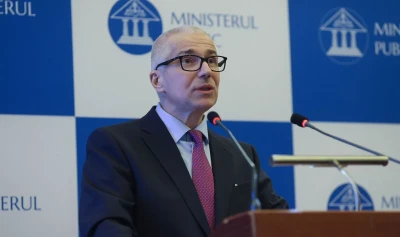


Justice Minister Radu Marinescu said on Tuesday that the procedure for the appointment of Romania's top prosecutors will comply with the legal timetable, as the interviews at the Supreme Council of Magistrates (CSM) will be completed, the legally required rehearing at the Justice Ministry will take place, and the final proposals will then be sent to President Nicusor Dan.
Marinescu emphasized that the absence of a favorable opinion from the CSM does not block the procedure and that the proposals can still be forwarded to the head of the state.
"As far as the CSM is concerned, the procedures are ongoing. As you know, the hearings are underway, and at the end, those who did not receive a favorable opinion will be heard again. My proposals are free of all subjectivity; they are based on the interviews held at the Justice Ministry, on the candidates' managerial projects, their submitted files, and the opinion of the Justice Ministry's commission. Once we see the concrete decisions and their reasoning - because in legal matters we speak about arguments, not speculation - we will proceed further," Marinescu said at the Parliament Palace when asked about the fact that Marius Voineag and Alex Florenta, the candidates for DIICOT deputy head and deputy Prosecutor General, respectively, didn't get CSM's greenlight, and whether he might withdraw their nominations as a result.
Asked whether he could have abstained from voting in the CSM, Marinescu replied that the law does not provide for any incompatibility preventing the Justice minister from voting in such cases.
"The legal mechanism involves a proposal from the Justice Ministry, an advisory opinion from the CSM - meaning that it must be considered but is not binding - and the final decision belongs to the President of Romania. This is not a personal proposal; it is an institutional procedure carried out according to the law. The law does not prohibit the Justice minister from voting. Abstaining without a legal basis would make no sense, and previous Justice ministers have also voted on such proposals," he explained.
Marinescu added that, as an ex officio member of the CSM, it is "logical and justified" for him to support the proposals he submits. "It would be absurd, under the current legal framework, for me to vote against my own proposal," he said.
Asked whether President NicuSor Dan could reject the nominations, Marinescu replied: "I follow the law. The law says the President decides. The law also says that I must make proposals based on solid arguments. I invite everyone to read the proposals - they contain pages of concrete reasoning, we are abiding by the law."

Regarding how Voineag (from the National Anti-Corruption Directorate) and Florenta (from the Directorate for Investigating Organised Crime and Terrorism) ended up applying for deputy positions at the Prosecutor General's Office and DIICOT, Marinescu said that he, the President, and many public figures encouraged prosecutors to apply, and those who felt they met the criteria did so. "At the Prosecutor General's Office there were two candidates; I had to choose. For the deputy position, only one person applied. Why he applied for this particular post and not another - you should ask him," he added.
Responding to criticism from the civil society, Marinescu said that the freedom of expression must be respected, but noted that the law does not list disciplinary sanctions as an obstacle to applying for these posts. "The civil society has an essential role in a democracy, but the procedure allows prosecutors who meet the legal requirements to apply. Disciplinary sanctions are not listed in the law as grounds for exclusion. Some candidates had such sanctions and were still allowed to participate. For me, this is not a political decision but one based on professionalism and the candidate's record," he said.
The minister reiterated that the procedure will follow the legal calendar: CSM interviews, the rehearing at the Justice Ministry, and finally the submission of proposals to the President. If the CSM fails to issue an opinion within the legal deadline, it is considered absent. "The President makes the appointment. If there is no opinion, the proposals are still sent to him," Marinescu said.
On Monday, the CSM's Prosecutors' Section again failed to reach a majority on the opinions for Alex Florenta (the candidate for DIICOT deputy chief prosecutor) and Marius Voineag (the candidate for deputy Prosecutor General). Both received three votes 'for' and three 'against', so that the vote will be repeated at a later date.





















Comentează