



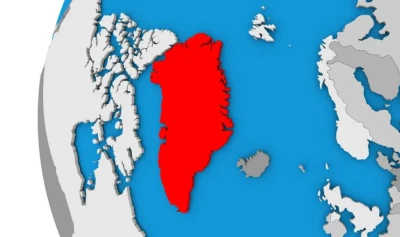


Tensions over Greenland are growing after US President Trump threatened fellow NATO allies with fresh tariffs over sending troops to the Arctic island. The EU now considers using its Anti-Coercion Instrument to fend off the US threats, while Denmark and its allies expand their military presence in Greenland.
European Union countries are rushing to find a joint response to threats by US President Donald Trump to impose an additional 10-percent tariff on goods from several European allies from February 1.
EU leaders are set to meet in Brussels on Thursday after Trump threatened that eight European countries would face higher tariffs until the United States secures what he described as the "complete and total purchase" of Greenland.
The US repeatedly said it wants the mineral-rich autonomous Danish territory of Greenland for 'national security', despite it already having a base on the island and long established security agreements with fellow NATO ally Denmark, which has controlled the Arctic island for about 300 years.
Denmark, Finland, France, Germany, the Netherlands, Norway, Sweden and the United Kingdom recently sent a small number of soldiers on a reconnaissance mission to Greenland as a sign of solidarity with Denmark, which is pushing back against Trump's takeover ambitions.
"We won't be blackmailed, and we stand together in solidarity in Europe," said German Finance Minister Lars Klingbeil, arriving in Brussels on Monday for two days of previously planned talks with his EU counterparts. "We don't want an escalation. We are not looking for an escalation, but we are ready if it comes," Klingbeil said.

Italian Prime Minister Giorgia Meloni - considered one of Trump's few allies in the EU - has called the new tariff threat a "mistake".
In a different threat scenario, Trump also ramped up his rhetoric against France on Tuesday, warning he would impose 200 percent tariffs on French wine and champagne over its intentions to decline his invitation to join his "Board of Peace" set up to oversee the rebuilding of Gaza.
French President Emmanuel Macron said at the World Economic Forum (WEF) in Davos (Switzerland) on Tuesday: "What doesn't make sense is to have tariffs between allies. We have to fix the war in Ukraine, we have to help the Ukrainians resist, and find a sustainable peace."
Macron called the possibility of potentially activating the Anti-Coercion Instrument against the US "crazy" and added: "I do regret that. But this is a consequence of just unpredictability and useless aggressivity."
European Commission President Ursula von der Leyen has warned Trump not to plunge transatlantic relations into a dangerous downward spiral over Greenland. "This is why the proposed additional tariffs are a mistake, especially between long-standing allies," she said in Davos.
Washington mayhem tests transatlantic alliance and post-WWII order
The leader of global rights group Amnesty International, Agnes Callamard, urged European countries Monday to stop "appeasing" Trump and to resist him and other "bullies" who she said were intent on destroying the rules-based order in place since World War II.
Since Trump's return to the White House a year ago, he has taken "a range of decisions that have led to the demise of many rules around the world", while Russia was destroying the system "through its aggression in Ukraine", the human rights organisation's secretary general told AFP in an interview in Davos.
The post-WWII order "is also being destroyed by Israel that has completely ignored international law in its genocide of Palestinians in Gaza", she added.
Furthermore, European powers have been treading a thin line over Ukraine in recent months, relying on Washington to try to help settle the conflict but resisting terms too favourable to Moscow.
Trump meanwhile has put the transatlantic alliance to the test with threats to take over Greenland "one way or the other", as European countries close ranks against Washington's designs on the vast Danish autonomous territory.
In a message to Norway's Prime Minister Jonas Gahr Store, Trump said "I no longer feel an obligation to think purely of Peace", citing his failure to win last year's Nobel Peace Prize despite openly coveting it. He said although peace would still be "predominant", he could "now think about what is good and proper for the United States of America".
Store said in a statement: "I have clearly explained, including to President Trump, what is well known - the prize is awarded by an independent Nobel Committee", not the Norwegian government.
NATO ramps up Greenland presence amid search for unity
Amid the global tensions, Denmark is proposing that NATO start surveillance operations in Greenland, with the support of the Arctic island, Defence Minister Troels Lund Poulsen said Monday after meeting NATO's chief Mark Rutte. The precise details of the proposal and the response from Rutte remain unknown.
While a number of NATO allies have sent troops to Greenland or have announced plans to do so despite the risk of additional US tariffs being imposed on them, others remain reluctant and divided over the move.
Belgium is sending a liaison officer to Greenland. Despite this decision, the country was not included on Trump's list of sanctioned countries on Saturday. "But there is no guarantee that this will not be the case in the future and we must show solidarity with our colleagues", Foreign minister Maxime Prévot said. He called the American measures "incomprehensible and unnecessarily hostile".
Likewise, Slovenia on Saturday announced it would deploy two Armed Forces officers to Greenland to take part in the planning and implementation of the Danish-led international military exercise Arctic Endurance.
Poland's Prime Minister Donald Tusk - whose country is a staunch NATO ally with the highest defence expenditure as a share of gross domestic product (GDP) in the EU - already said last week the country was "not planning to send Polish soldiers to Greenland".
Contrary to false claims on social media that Germany had sent warships to Greenland, the country did send 15 soldiers to the island for a reconnaissance mission. The troops however left Greenland on Sunday after the mission was completed on schedule, according to the Ministry of Defence.
Spain has not announced plans to participate in the mission in Greenland. Defence Minister Margarita Robles however said recently that the country could join the group in the future.
At the same time, some NATO allies are still navigating how the Greenland dispute plays out in their domestic political debates.
Asked on Monday whether the government of the Czech Republic supports Greenland, Prime Minister Andrej Babi said he could not give a clear answer. He added that the United States is the leader of NATO and that conflicts are counterproductive. "We definitely prefer that an agreement be reached within the alliance. It would be very unfortunate if there were to be any conflicts," Babi said.
In Bulgaria, political reactions are mixed. The outgoing government has not issued a position on the recent developments around Greenland, but reactions from parliament have begun to emerge.
On the one hand, the leader of Continue the Change - a party affiliated at European level with Renew Europe - Assen Vassilev, said that every country should have the right to determine its own future, rather than having its choices dictated by external powers.
On the other hand, Revival (Vazrazhdane) - whose MEPs sit with the Europe of Sovereign Nations Group in the European Parliament - backs the US claims over Greenland. Party leader Kostadin Kostadinov reiterated the party's call for Bulgaria to withdraw from NATO and argued that tensions between Washington and Copenhagen expose deeper structural problems within both NATO and the European Union.
Slovakia's Foreign Minister Juraj Blanár said "Slovakia considers Greenland to be part of Denmark". He rejected tariff battles between states: "We prefer diplomacy and peace, not tension or fighting," he said.
EU "trade bazooka" on standby
EU leaders will meet in Brussels on Thursday to discuss a coordinated response to the prospect of US tariffs - with its most powerful trade tool on the table.
The Anti-Coercion Instrument, a mechanism adopted in 2023, that can be used in cases of economic coercion when a non-EU country attempts to pressure the bloc or one of its 27 members into making a decision through trade restrictions.
Such practices "unduly interfere with the legitimate sovereign choices of the European Union and its member states", the European Commission says on its website.
France had signalled its intention to request the activation of the instrument after Trump announced on Saturday that he would impose additional tariffs on the eight NATO allies.
To apply the instrument, the European Commission first has to examine whether economic coercion is present in the case. EU countries must then back the Commission's conclusion, before the EU's executive arm ideally enters into talks with the country. If these are unsuccessful, the EU can impose countermeasures.
Retaliatory measures under the ACI however are only a last resort and must be proportionate. Using it against the United States would be "the very first time" the EU has ever applied the tool, Macron recalled in Davos on Tuesday.
Should the ACI be applied over Trump's latest trade threats, retaliatory tariffs on imports of US goods are likely. The EU-US tariff agreement concluded in July could also be put on hold.
Under discussion is also the possibility of imposing additional tariffs on a list of goods with a total trade volume of 93 billion Euro (108 billion Dollar), including industrial and agricultural goods such as motorcycles, beef, whiskey and citrus fruits.
The content of this article is based on reporting by AFP, ANSA, Belga, BTA, CTK, dpa, EFE, STA, PAP, TASR as part of the European Newsroom (enr) project.














Comentează