



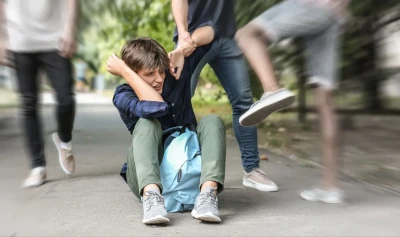


AGERPRES special correspondent Florin Stefan reports: Romanian MEPs generally agree with introducing a minimum age for access to social networks, although they stress that such a measure would only partially address the problem. They put forward additional solutions, including criminalizing online harassment and appointing a special coordinator within the Ministry of Education or the Government to oversee the implementation of the European Commission's action plan against cyberbullying.
The European Commission adopted on Tuesday - International Safer Internet Day - an action plan aimed at protecting the mental health of children and adolescents in the EU online environment. On the same day, the European Parliament held a debate on the topic, which continues to divide public opinion across Europe.
"The phenomenon has gone beyond the level of play; I think we can speak of psychological warfare. One in six children reports being affected. One in nine people say they have been involved in cyberbullying or have done it at some point. And this is more dangerous than what I knew in my time, when bullying at school was real but ended when the bell rang for the end of the day. Now it lasts all day and all night, it happens online, and things have gotten out of hand," said Save Romania Union MEP Vlad Voiculescu in Strasbourg.
He is among those who support verifying children's ages. "If you have to be a certain age to enter a bar, I think it is valid to discuss verifying the age of someone joining a social network," Voiculescu added.
Asked about age restrictions on digital platforms, Liberal MEP Siegfried Muresan argued that there is no "magic bullet" for tackling online abuse, which he links to the broader risks of digital disinformation.
"Authorities have an obligation to create a framework that protects citizens, and if certain limits must be set so that social networks can no longer be used freely to incite hatred, even violence, division, and disinformation, then clearly such rules must exist. But there is no magic bullet," Muresan said.
European Parliament Vice-President Nicu Stefanuta welcomed the fact that Emergency Management Department head Raed Arafat raised the issue of introducing an age limit for social media access in Romania, noting that "an age limit for social networks is something to consider".
"The French had a reason to do it. Social networks are built with addictive algorithms - the infinite scroll, the so-called 'brain rot' phenomenon, and many others. So we must think about adding phones and social networks to the list of things already banned in schools, such as alcohol and smoking," said Stefanuta, who was elected as an independent and is now affiliated with the Greens.
The other Romanian EP Vice-President, Victor Negrescu also argued that "we need to have a debate about the age of access to these platforms". At the same time, he supports the clear identification of users in the online environment. "I personally advocate for the need to clearly identify users of online platforms, so that only legal actions take place in the virtual space and, obviously, to protect freedom of expression, which would in fact be strengthened by this clear identification," he explained.
However, Negrescu rejected concerns about excessive collection of personal data, noting that "platforms today have a responsibility to protect this data and to collect only what is relevant".
What measures are being proposed, and how realistic are they?
Regarding potential tools to combat online harassment and intimidation, Vlad Voiculescu said that "Romania does not have different problems compared to other EU countries".
"The problems are the same, so solutions must be defined at European level. There should be a phone line in every member state that people can call in cases of cyberbullying, and also 'red flags' marking any content that includes cyberbullying. And not only social-media content, but also mechanisms such as targeted advertising that is inappropriate for minors," the USR MEP said.
Nicu Stefanuta argued that legislation against online harassment must be strict, stressing that he no longer wants to hear about "12-year-olds committing suicide because of a picture lost somewhere, it's not normal".
"My position has been consistent. In the previous term there was a proposal to criminalize cyberbullying, that is to define as a crime the act of picking on someone online, writing to them endlessly, posting intimate images of someone. Romania also has a law on revenge porn, because our children are affected by these issues. An intimate picture that ends up online can lead to suicide. Therefore we need firm legislation to stop these practices. I support such laws," Stefanuta said.
Siegfried Muresan emphasized the need to understand that just as people can be victims of radicalization, harassment or intimidation in real life, the same can happen online.
"That is why we need educational measures, not only for young people but also for parents. Parents today are not able to protect their children online," he argued.
Victor Negrescu added that society needs "a real debate about bullying and cyberbullying, creating a safe space for victims to speak".
"A functional mechanism must be developed to support bullying victims, whether in schools, in social-protection services, or through proper guidance for teachers and parents. These measures must be implemented effectively and properly monitored. The European action plan includes recommendations that must be followed by national regulations protecting both users and victims, and clearly defining the role of social platforms," he said.
But will these European-level measures be effective? Social Democrat MEP Andi Cristea expressed skepticism.
"We can make laws, regulations, lay out instructions on how to use technology, but in the end it comes down to individual responsibility. People can only be protected if they protect themselves. What the Commission proposes is legitimate and we support it. But effectiveness? I have my doubts," Cristea said.
Are EU member states ready to implement the action plan?
"Unfortunately, I think that many member states are not ready, and Romania is not ready either. We must be realistic, the plan has just been adopted," Negrescu said.
For this reason, he believes "there should be a special coordinator within the Ministry of Education, if not at Government level, to oversee implementation, supported by an advisory council including youth representatives, educators, civil-society actors and social partners, to ensure the most effective coordination possible".
He added that, in his opinion, cyberbullying is "a social phenomenon kept under wraps by the political class, which often ignores these issues, treats them as taboo and considers them unimportant".
Nicu Stefanuta agrees, arguing that Romanian politicians usually act only under public pressure.
"If there is enough public pressure, Romanian politicians usually give in. We need to also act in the digital sphere and in protecting minors. Without public pressure, almost nothing happens in Romania, or what happens is not good. The political class responds only to strong stimuli and to large numbers of voters putting their energy into something," he said.
Andi Cristea, however, warns that consensus and public attention to the planned measures are not enough, given that most apps and platforms used in Europe are not European.
"If we audited the apps on our phones, we would find that less than 10% are made by European companies. Others build the technological platforms, and we, Europeans, insist to regulate and over-regulate them. It's as if someone else makes the technology and we write the instructions for our citizens on how to use it. Conceptually, it feels like trying to force good on someone," he said.












Comentează