



At a ceremony hosted by the Cotroceni Presidential Palace on Tuesday, President Klaus Iohannis signed a decree promulgating a law on the establishment of the National Museum of Jewish History and the Holocaust in Romania.
"I have promulgated this law thinking about history, about present and especially about the future. Thirty years ago, Romanians gained their freedom with the cost of supreme sacrifice. Among the dreams and aspirations of those who sacrificed themselves on the barricades erected with empty arms against a criminal regime was the desire never to live in a lie, that is to say, to be able to write one's own story - an unvarnished, true story that encompasses both the feats of bravery and what was wrong and dishonorable in our past. Such a wonderful and tragic legacy had been hidden from us and our parents for decades. It is the history of the Romanian Jews and their invaluable contribution to the development of our country, but also their WWII tragedy, whether lending a hand to laying the foundations of the first modern institutions, or giving their lives on the battlefields at Marasesti and Oituz; whether honoruring honored the Romanian culture through their achievements, or boosting economic development and making a decisive contribution to sciences, the Jewish legacy has enriched our identity. The Jewish heritage is representative of the national culture, and the future National Museum of Jewish and Holocaust History in Romania will have the mission to highlight it," Iohannis said at the ceremony.
He underscored that the fundamental mission of the future museum will be to "ensure that the memory of all those who, with their dignity trampled under, fallen prey to cold, hunger and diseases, were tortured and, finally killed."
"I believe that this project is one that unites, not one that divides. The union of our memories is a common good. Therefore, I hope that this museum will bring us together. (...) You will all agree that the museum has to be an institution of the future, an ally of education against ignorance, a fortress of solidarity and civic patriotism in the face of intolerance, anti-Semitism and discrimination. Whoever will pass its threshold will be more enriched, because they will understand something that will go down in their heart and soul: that indifference can kill, that the responsibility of the citizen means to defend the disadvantaged, that diversity is not toxic, but necessary, that making democracy fragile means an attack on social peace, that tolerance and good understanding start with education. Ultimately, the sacred mission of this institution will be to confirm the right of all people to live in dignity. It also opens a new chapter in taking responsibility for and recognising the historical past as a founding element for understanding and progress and an homage to all those who have strived for the values of today's Romania," said Iohannis.
He added that if accepted, he will host the first meeting of the museum's Honorary Council at the Cotroceni Presidential Palace.
The law was sponsored by MP Silviu Vexler of the national minorities' floor group.
"The museum is something that first of all should become a source of tolerance, civic involvement, and especially the key point of combating anti-Semitism and Holocaust denial, the attempts to rehabilitate the legionary movement and of Ion Antonescu, an increasingly bigger presence on the Internet. The museum should first and foremost talk to young people and future generations. (...) I trust that the Ellie Wisel Institute in collaboration with the Federation of Jewish Communities in Romania will turn it into a world-acclaimed institution. The museum is not of the Jewish communities or only of the Jews; it is a museum of present and future Romania," Vexler said.
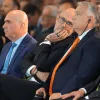
Attending the ceremony were Speaker of the Chamber of Deputies Marcel Ciolacu; US ambassador to Romania Hans Klemm; national leader of the National Liberal Party (PNL) Ludovic Orban; national leader of the People's Movement Party (PMP) Eugen Tomac, lawmakers, representatives, Jewish community leaders, and state advisers.
Under the promulgated law, the National Museum of Jewish and Holocaust History in Romania is located on 218 Calea Victoriei. Funding is provided from the national budget via the Elie Wiesel National Institute for Holocaust Studies in Romania, own revenues, donations and sponsorships.
The museum is designed to showcase and promote the history of the culture and traditions of the Jewish communities of Romania, to protect Holocaust victims and fight against anti-Semitism.
President Iohannis promulgates law establishing Holocaust Museum in Romania
Distribuie articolul


București 14°C
14°C
14°CArticole Similare
33
Archpriest Zaharia Peres: Easter Radiance breaks the darkness and restores eternal Light
33

28
Romania secures 2 - 0 win over Georgia in Billie Jean King Cup play-off
28
27
Cardinal Claudiu in Easter Pastoral Letter:Church teaches the power of light cannot be wiped out by darkness
27
21
Patriarch Daniel's Easter message calls for peace, compassion and good deeds
21
16
Cotroceni Palace to host Bucharest Nine and Nordic Summit on May 13
16
26
Foraj Sonde Videle acquires Raffles Energy and Zenith Resources; deal expected to close by end-August
26
27
Football icon Mircea Lucescu laid to rest with military honors
27

12
CCIR president urges shift from Chinese commercial presence to real investments in Romania
12
30
Philip Morris International Presents its Value Report 2025: change in motion
30

34
Tennis player Sorana Cirstea qualifies for semifinals of doubles event in Linz (WTA)
34

18
Romania men's national water polo team at third consecutive win in World Cup's Division II
18

20
Romania women's tennis team wins first match against France in Billie Jean King Cup
20

21
BNR's Badea: Euro adoption, a strategic goal tied to Romania's economic integration and institutional maturation
21







Comentează