



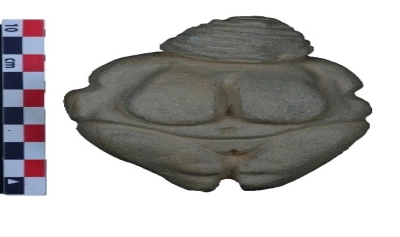


A clay female figurine dating back more than 7,500 years has recently been discovered near the town of Sfantu Gheorghe, Covasna County, by a team of archaeologists from the National Museum of the Eastern Carpathians, the institution announced on Tuesday.
According to museum representatives, the discovery was made during preventive archaeological research in the Arcus-Targului Plateau (Vasarteto) area, carried out in the context of works to expand the electricity networks serving the Sepsi Arena zone.
The excavations revealed traces of a Neolithic settlement dated between 5800 and 5500 BC, belonging to the Starcevo-Cris culture, one of the earliest agricultural cultures in south-eastern Europe. The figurine was found inside a dwelling more than seven millennia old, among pottery fragments, traces of burnt clay and charcoal.
"The figurine, only six centimetres tall, was modelled from clay mixed with chaff and sand and then fired at a high temperature. It has a light brick-red colour, with darker brown shades on the front, indicating greater exposure to fire. The face is not detailed, but the essential features are visible: eyes incised in a 'V' shape, a small oval nose and fine lines depicting long hair, probably tied in a bun - one of the oldest known representations of a female hairstyle in the area north of the Danube. The arms, modelled laterally, appear to be raised, and two small protrusions on the front indicate the breasts, clearly identifying the figure as female. This posture, with open arms, was typical of Neolithic representations, symbolising prayer, invocation or communion with the divinity," archaeologist Dan-Lucian Buzea said, as quoted in a post on the museum's Facebook page.
Specialists believe the figurine may have had a ritual role, possibly used as an offering, an amulet or an object linked to fertility or household protection. Regardless of its original function, the artefact offers valuable insight into early Neolithic communities.


"Such figurines are rare within the Starcevo-Cris culture, which makes the Arcus discovery all the more significant. Most of the 'idols' known from the same period come from the Banat region or the Cris area and often have pronounced Venus'-type forms, with exaggerated hips symbolising fertility. The Arcus figurine, however, is different: it lacks exaggerated features and instead presents a slender, simple silhouette that remains highly expressive," the press release added.
The research was carried out by a team from the National Museum of the Eastern Carpathians in Sfantu Gheorghe, coordinated by Dr Dan-Calin Stefan, together with Dr Dan-Lucian Buzea and Dr Puskas Jozsef, with the support of independent collaborating archaeologists.




























Comentează