



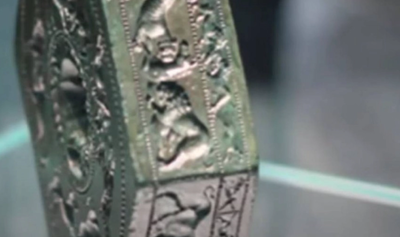


An archaeological artifact dating from the Roman period (2nd - 3rd century AD), a statuette of the Genius or Genius cucullatus type discovered in the settlement near the Roman fort at Cristesti (Mures County) is the star of the exhibition marking the 90-year history of the Mures County Museum, titled 'Pages from the History of a Museum. Examples from Targu Mures'.
"The statue holds a cornucopia in its left hand, only partially preserved, and represents a man wearing a long cloak thrown over his left shoulder. The garment leaves his muscular chest exposed but covers the lower part of his body down to his ankles. The right hand, now lost, probably held a patera - a vessel used for sacrifices. His long, rich hair falls in curls on his shoulders, and on his head he wears a high modius (a cylindrical diadem). On his feet he has schematically rendered sandals, and near his left foot appears the figure of a man sitting in a boat, fighting the waves. The marble from which the statue is carved comes from Asia Minor, and the influences of oriental workshops are clearly visible both in the shape of the crown and in the rendering of the physical features. Therefore, it can be stated with considerable certainty that the piece is an imported artwork," the description of the artifact states.
According to the cited source, the only known parallel from the former Roman province of Dacia is a marble relief discovered in Alba Iulia, which undoubtedly represents the Genius nautarum, the patron deity of those involved in river transport.
"During the imperial period, people who practiced certain crafts were organized into professional civil associations called collegia. Although no inscription was discovered at Cristesti to confirm the existence of a collegium nautarum, this representation allows the identification of the divinity as the Genius (collegii) nautarum," the description of the exhibited statuette also notes.
The head of the Mures County Museum's History Section, Szilard Sandor Gal, told AGERPRES that in the case of this statue, the hypothesis that it represents Genius fluminis, the personification of the Mures River whose divine protection supposedly extended to the entire settlement, cannot be ruled out.


"However, the context of the discovery also suggests that the so-called building with an apse uncovered at Cristesti could have served as the headquarters of this collegium, as professional civil associations were called. The statuette represents a Genius, often associated in rural areas with a protective divinity, who wears a helmet or a hooded cape (cucullus), hence the name Genius cucullatus," Szilard Sandor Gal explained.
The commune of Cristesti, located about six kilometers from Targu Mures, is recognized as a major archaeological site, with a rich history spanning from the Neolithic to the post-Roman period.
"Archaeological excavations in the Roman and Daco-Roman settlement (2nd - 4th centuries AD) have revealed a vast habitat with artisan workshops, cult vestiges, an alabaster head of the goddess Juno, stamped bricks indicating official or military structures, post-Aurelian coins, and traces of habitation belonging to the Wietenberg culture (Second Bronze Age). These discoveries were made during several campaigns. The most significant finds relate to a large Daco-Roman settlement, and besides the Genius-type statue, the exhibition also includes other objects discovered here, as well as a fragmentary limestone funerary stele depicting a small sanctuary with composite capitals and columns decorated with grape clusters and vine leaves," said Iulia Vizi, communication representative of the Mures County Museum.
The temporary exhibition "Pages from the History of a Museum. Examples from Targu Mures" explores the role museum institutions played in shaping national identities in the 19th and 20th centuries, including through reconstructions based on period documents and images.
The project brings together seven thematic modules and a final one that recreates fragments of the permanent exhibitions that have existed in Targu Mures over time.
Alongside the "Roman Hall", visitors can explore other collections that once functioned as museums in the city: academic and private collections from the 19th century, the Industrial Museum of Szeklerland (1886), Aurel Filimon's ethnographic exhibition (1936), archaeological research at the Roman site of Cristesti, permanent exhibitions from the communist period (1957 and 1970), and the Bernády Art Gallery (1913).
"Each room functions as an 'exhibition within an exhibition', with objects displayed in the atmosphere of their original era and accompanied by two levels of interpretation: texts recovered from contemporary documents and current curatorial explanations. Visitors are invited to observe how communication and presentation methods have evolved over time," said Szilard Sandor Gal.
He added that this is the newest exhibition of the History Department, covering 90 years of museum activity in Targu Mures, built around a unique concept that brings together all collections linked to the institution's origins - from the Industrial Museum of Szeklerland, to the Reformed College collection, the Romanian collection, Aurel Filimon's ethnographic holdings, the impressive paintings of former mayor Bernády György, and the ways museum spaces were used for political propaganda during the communist period.
"The final room gathers a symbolic object from each module, repositioned in a contemporary setting to show how time and ideas reshape the meaning of objects. It is designed as a space for play between past and present, with tablets alongside parchment-style documents hidden from view, accessible through rolling scrolls," the expert explained.
The rolling scrolls also include the account of how another valuable statuette was discovered at the Cristesti site: that of the goddess Juno, wife of Jupiter and protector of marriages.




















Comentează