



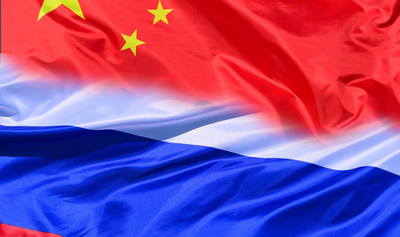


There is a coherent signal given by the U.S. that the main counterpart in nuclear talks has become China today, and not the Russian Federation, foreign policy and security analyst Iulian Chifu told AGERPRES on Thursday.
He referred to the expiration of New START, the last nuclear arms control treaty between Russia and the U.S.
"The signal also comes and marks the fact that at the moment we certainly no longer have superpowers, but we have two great powers and that the two great powers are the U.S. and China, not Russia, even if Russia remains with its solid arsenal. We also have a new issue, which is related to the quality of this weaponry. We know very well that the Russian Federation has deployed the number that was in the START treaty of warheads and nuclear capabilities, it has a lot of stockpiles, up to about six thousand there were, but they are mostly Soviet production, there are very few that are of new production, including when we talk about carriers or the famous discussion on hypersonic missiles. So they are a restricted level," the expert said.
On the other hand, the U.S.has undergone a process of renewal, which has been done periodically.
"There are still nuclear capabilities that come back, of course, post-Cold War and lately, at least in the last year, there is a decision, we will also see the final document on the nuclear posture of the United States, which has brought back the replacement with new capabilities, including new carriers."
At the same time, China does not want control on its own soil over national nuclear capabilities.
"The biggest concern is China, which is known to reach a form of, let's say, comparability, if not parity, because it will reach over 1,000 warheads by 2030 and some voices say even before 2030, at the level of 2028. All these things, nuclear missiles, China's nuclear weapons, are state-of-the-art production, so they have a much higher value and much more developed capabilities. And this is where concern comes in. On the other hand, China does not want any kind of nuclear agreement, in the sense that it does not want international control over its own territory regarding its nuclear capabilities, and this is the big problem and the big question mark."
The expert said that the U.S. does not particularly consider that the Russian Federation "is a partner with whom it deserves to sign an agreement as parity, as parity of weight, of course, geopolitical and it wants with China, which does not want to have control over its own soil."

Chifu says that, in time, there will be formulas "for exit and conclusion and for agreements that will first of all reassure public opinion, but reintroduce the formulas for controlling nuclear weapons."
As for NATO's call for restraint and responsibility in this new context, Chifu said that "it is primarily about avoiding the infamous display of the nuclear weapon, which the Russian Federation has been doing for some time.
"He even has a favourite spokesman in threatening the use of nuclear weapons, with the placement of nuclear weapons at NATO's borders. I am referring to Dmitry Medvedev, deputy chairman of the Security Council. This reticence is an invitation for the parties not to use. In fact, in the versions of the old treaties, none of the big players in the era of the superpowers, the Soviet Union and the United States, threatened to use nuclear weapons; on the contrary, they had reached the very clear conclusion of mutually assured destruction. Consequently, they had all the tools, so that there was no question of one of them using a nuclear weapon."
He added that on December 14, 2014, the new military doctrine of the Russian Federation marked for the first time the use of nuclear weapons in a regional conventional conflict in which its interests are affected.
"So, basically, the Russian Federation, successor to treaties with the Soviet Union, assumed that it could use nuclear weapons in conventional conflict, as a first blow. Moreover, the debate within the Russian Federation is even wider. It was discussed what a champion is Sergei Karaganov, who is the head of Putin's Valdai group and Putin's adviser, it was talked about the fact that an eventual coup with the dimension of theatre, a nuclear strike in Ukraine, would not determine the escalation and nuclear counter-retort. Of course, the debate is ongoing, the weapon has not been used and most likely will not be used on the ground, because it does not bring practical advantages, but the debate has been held and the concern is very natural with everything that means a possible nuclear strike of any size, even under a megaton, such as those I was talking about in the theories of Karaganov and those around him."
At the European level, there are two nations that possess nuclear weapons - France and the United Kingdom.
"In the European Union, after Brexit, we have only one state that has nuclear weapons, and that is France. And there is already a debate on the table - I last heard it launched and circulated at the level of the Norwegian state leadership - on a formula for the development of a European nuclear umbrella, in which France and the UK would collaborate. In fact, there is an agreement between the two of collaboration and agreement on the type of reaction. And, possibly with European funds, an alternative option is being sought, first on German funds, and also of other member states."
Chifu also said that this type of project comes up against the perspective of efficiency and costs, "given that there is the American umbrella, to build such an umbrella (...) would first of all involve doubling the budgets from 5 to 10% and would mean very high costs, not to mention the problems that could fall under the non-proliferation treaty, namely the placement of nuclear weapons in states other than those that possess them today, France an the UK".
***
The last nuclear arms control treaty between the U.S. and Russia expired on Thursday, marking a major turning point in the history of nuclear arms control since the Cold War and rekindling proliferation concerns.
The Treaty between the United States of America and the Russian Federation on Measures for the Further Reduction and Limitation of Strategic Offensive Arms, also known as the New START Treaty, was signed on April 8, 2010, in Prague. It entered into force on February 5, 2011.
According to the U.S. Department of State, both the U.S. and the Russian Federation met the central limits of the New START Treaty by February 5, 2018, and have stayed at or below them ever since. Those limits are: 700 deployed intercontinental ballistic missiles (ICBMs), deployed submarine-launched ballistic missiles (SLBMs), and deployed heavy bombers equipped for nuclear armaments;1,550 nuclear warheads on deployed ICBMs, deployed SLBMs, and deployed heavy bombers equipped for nuclear armaments (each such heavy bomber is counted as one warhead toward this limit), and 800 deployed and non-deployed ICBM launchers, SLBM launchers, and heavy bombers equipped for nuclear armaments.


















Comentează