



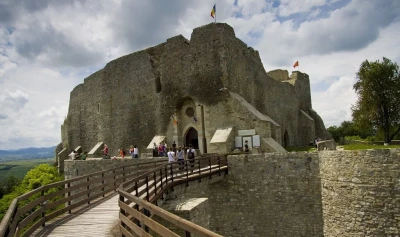


An exhibition blending historical artefacts with compelling life stories, titled "The Fortified City", is set to transport visitors to the turbulent early modern period that shaped the local community, from guilds essential to the urban economy to the culinary customs of the time, within the Medieval Citadel of Targu Mures.
The exhibition offers a vivid portrait of a time of major transition for the city, structured around thematic modules exploring social, economic and cultural frameworks. This historical journey is anchored in remarkable stories, such as that of "witch" Katalin Sardi, whose ordeal sheds light on the complexity of the legal system of the era.
"What makes the exhibition truly unique is its innovative approach to bringing the past into the present through life stories that bridge past and present. One example is the story of 'witch' Katalin Sardi, accused of witchcraft in 1682, whose case is used by the curators to illustrate the justice system of the time and highlight the complex relationship between law and community. Equally striking is the narrative of Ferenc Nagy Szabo, which reveals the challenges and achievements of a tailor seeking citizenship and personal success, underlining the delicate interplay between law and community. Moreover, the unique mix of artefacts and narratives enriches the visitors' cultural experience," Iulia Vizi, communications representative of the Mures County Museum, told AGERPRES.
The exhibition is strategically housed in a building within the Medieval Citadel of Targu Mures, the most important structure of the community in the 17th century.
Given the symbolic nature of the venue, known locally as the former barracks of the Habsburg garrison, the exhibition opens with a presentation of the building's history through a 3D reconstruction.
"Although its past is not fully clear, we know that the core of the current building consists of two early modern residential houses. The first Habsburg garrison barracks, which expropriated the citadel for military purposes, was built in the 18th century using parts of these two houses. The building's current form dates from the late 19th century. The history of the former command building is illustrated through a 3D reconstruction," the curators explain.


Before entering the thematic halls, visitors learn about the granting of free royal city status in 1616, its significance and consequences, the change of the city's name and the awarding of its coat of arms.
The central exhibit is the city's first seal, dating from 1620.
Visitors also discover that on 29 April 1616, Prince of Transylvania Gabriel Bethlen granted Targu Mures the status of free royal city.
"The circumstances of drafting the charter and the reasons for issuing it during the Diet of Alba Iulia in 1616 are not known. The charter is a large parchment document; in its upper left corner one can see the coat of arms granted to the city, framed within a medallion of concentric ornamental patterns. Its authenticity is confirmed by the prince's signature. The document bears a hanging seal on a multicoloured cord: red, yellow, green and purple. The original hanging seal is an impression in red wax set within a natural-coloured wax frame. The prince's first seal from 1613 was used to authenticate the document," the exhibition catalogue notes.
The exhibition also shows that in the early modern period Targu Mures became the most important craft centre in the region, with economic life dominated by guild-based production.
"Craftsmen organised themselves into professional associations defending their economic interests, following models from Saxon towns in Transylvania. The earliest guilds included butchers (1493), tailors (1514), furriers (1520), saddlers and belt makers (1513), rope makers (1579) and tanners (1584). By the mid-17th century, their number had grown significantly, with the addition of surgeons, wheelwrights, coopers, locksmiths, blacksmiths, shoemakers, potters, goldsmiths and others," the catalogue states.
Wealthier guilds were tasked with building, maintaining and defending towers and bastions, while less affluent ones had similar responsibilities for the city walls, according to the curators.
The exhibition also highlights that a Protestant school, Schola Particula, was established in the former Franciscan monastery in the citadel following a decision by the Transylvanian Diet in 1557, benefiting from princely support in the form of an annual donation.
By the mid-16th century, most inhabitants of the privileged town had embraced Protestant denominations, with the majority adopting the Helvetic confession, giving rise to one of the earliest and most important Reformed communities in the Principality of Transylvania.
In terms of gastronomy, the exhibition reveals lesser-known aspects, such as the absence of major regional differences in cooking methods during the medieval and early modern periods, although culinary distinctions later followed political changes.
"With the formation of the Principality of Transylvania, its cuisine developed distinct characteristics, retaining Renaissance features even into the early modern period. This process was only interrupted when Transylvania became part of the Habsburg Empire. In the 18th and 19th centuries, a distinct Transylvanian cuisine emerged. Research into early modern gastronomy mainly reflects the diet of the nobility and their servants, as information about the majority of the population is scarce. The latter likely consumed bread and various porridges, later vegetable soups. The elite ate twice a day, with the main meal at around 9-10 in the morning and dinner at 17-18," the catalogue explains.
Meat formed the basis of the diet, with beef most common, while pork and lamb were considered more valuable. Poultry was served on festive occasions, and freshwater fish such as pike, carp and crucian carp were widely consumed, with nobles also familiar with salmon.
"Fish was also eaten on fasting days, and large towns usually had fishponds. Diet was strongly influenced by religious rules, with the medieval Catholic Church allowing 250 days with meat and 110 fasting days. Although Targu Mures inhabitants converted to Calvinism in the second half of the 16th century, dietary changes occurred relatively slowly," the curators add.
Silver and pewter objects displayed in the exhibition are presented as key markers of social status and wealth accumulation in the 17th and 18th centuries.
"Silver pieces, valued for both their material and symbolic worth, were used not only for decoration but also as reserves of capital in economically unstable times. These luxury items reflected the social status of their owners and were often gifted or collected. While most silver objects were decorative, pewter vessels were used for serving food and drink, symbolising modesty and responsibility. Within guilds, pewter items reflected bourgeois dining culture, with drinking vessels among the most common, though rarely used in everyday life. Cultural changes in the 18th century, including the spread of faience and European porcelain, gradually reduced the use of silver and pewter," the curators note.
The exhibition offers more than a history lesson, Iulia Vizi adds, serving as a reflection on the challenges and progress experienced by Targu Mures as a society.
"By combining thematic modules covering social, economic and cultural aspects, the exhibition creates an interactive and educational experience. Visitors are invited to explore not only period objects but also visual and multimedia narratives that recreate a time of cultural dynamism and urban transformation. 'The Fortified City' is more than an exhibition; it is an invitation to better understand the spirit of a city at the crossroads of tradition and modernity, a cultural landmark enriching the historical heritage of Targu Mures," she said.
The exhibition spans 120 square metres and was developed under the coordination of Gyorfi Zalan and Tamas Sarandi, together with a team of specialists from the Mures County Museum.
























Comentează