



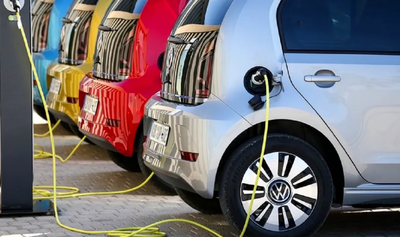


Electric vehicles could become a major tool for balancing Europe's electricity grids as renewable generation and power demand surge, but this potential depends on smart charging, infrastructure and regulation, shows an EY - Eurelectric report.
Compared to the past four decades, Europe's electricity consumption is expected to grow four times faster over the next 25 years, exceeding 4,500 TWh by 2050, while renewables already account for 45% of power generation. Variability is increasing: in the first eight months of 2024, Europe recorded 7,841 hours of negative electricity prices, requiring system flexibility in balancing fast demand and supply.
Electric vehicles can be part of the solution, provide such flexibility through smart charging (V1G) - shifting charging to low-cost or surplus-energy periods - and later through bidirectional charging (V2G), where cars feed energy back into the grid.
By 2030, EV batteries in Europe could offer 114 TWh for V2X applications, equal to 4% of annual EU electricity consumption and enough to power 30 million homes for a year. Flexibility from EVs could save grid operators around 4 billion annually and reduce the projected 67 billion/year grid-upgrade bill to 55 billion, the report notes.
Consumer benefits are also significant: in the UK, annual savings for EV owners can reach 19% for compact cars and 26% for large/SUV models when flexibility mechanisms are used.
The report underscores that EVs can become strategic assets for Europe's energy system - if clear rules, data access and viable business models are put in place.


For Romania, the national energy mix already includes a significant share of renewables, including hydropower, while photovoltaic and wind capacity has expanded in recent years. At the same time, the electric-vehicle market is growing, supported by national programs and broader European trends. This reproduces, at national scale, the dynamics described in the report: more variable generation and more electrification.
Three major directions emerge for Romania, the first being managing consumption peaks.
Without systems that shift charging to night-time hours, a rising number of EVs could increase pressure on the grid during evening peaks. The report notes that flexibility is cheaper and more efficient than relying solely on grid expansion. For Romania, where grid investment is already challenging, smart charging could ease the load on distribution operators, the document states.
A second direction is capturing surplus renewable energy.
Romania has already experienced intervals with high renewable output. The model described in the report, where EVs absorb surplus energy and can reinject it later, could become a practical tool for stabilizing the national grid. As solar capacity grows, the risk of temporary imbalances will also rise. Batteries distributed across thousands of EVs can operate in a decentralized way to balance the system, reads the report.
The third direction concerns economic opportunities for consumers and businesses.
In some markets, drivers achieve substantial savings by participating in flexibility schemes. For Romania, where price sensitivity is high, clear financial incentives could accelerate both EV adoption and the use of smart tariffs. Fleet operators, public transport, logistics companies and firms with large parking areas could also become active flexibility providers, reducing costs and generating new revenue streams.
To support these developments, rapid expansion of charging infrastructure is essential. In this context, the E-Move and E-Mobility programs are key tools, offering non-repayable funding for public and corporate charging networks. In parallel, the financing scheme for zero-emission vehicles will help renew the national fleet.
The report highlights the need for interoperability, data access and a regulatory framework that enables energy exchange and monetisation of flexibility. For Romania, this means: clear and attractive time-of-use tariffs; infrastructure compatible with smart and bidirectional charging; tax rules that avoid double taxation of stored energy; and integrating EVs into national strategies for flexibility and storage.
Romania has the advantage of learning from the experience of other European countries. The growth of the EV fleet can also be treated as an opportunity to balance the electricity grid, the document concludes.
EY employs over 1,000 people in Romania and the Republic of Moldova, providing integrated audit, tax, legal, strategy, transaction and consulting services to multinational and local companies.




























Comentează