





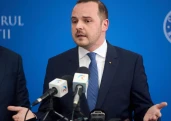
Prosecutor Bogdan Staicu, vice president of the Supreme Council of Magistrates (CSM), warned on Tuesday that there is "a very high level of frustration" among magistrates over the new retirement rules, adding that the judiciary faces risks such as demotivation, mechanical fulfillment of duties, and the spread of conformist behavior.
Speaking at the presentation of the General Prosecutor's Office annual activity report, Staicu said the entire judicial system is "at a turning point" following the Constitutional Court's ruling on magistrates' special pensions. He argued that magistrates might have accepted the new retirement law if two conditions had been met: a fair phasing-in of the new rules, and a reasonable pension level, consistent with CJEU case law.
Instead, he said, many active magistrates now face significantly harsher conditions, both in terms of retirement age, and seniority. Some have effectively had 17 years added to their retirement horizon, and the new rules halve pension amounts compared to those who retired at the end of 2023.
According to Staicu, the coexistence of three separate retirement regimes has deepened dissatisfaction: "I am convinced there is a very high level of frustration, especially among those affected by the most recent changes," he said, warning that the consequences could be serious: loss of motivation, routine, mechanical performance of duties, a rise in conformism, which he described as incompatible with the critical thinking and proactive attitude required for high-quality justice.
"We have reached a point where conformism is not the right path for the prosecutor's office," he said, stressing that prosecutors must represent the general interests of society rather than "passively adapt ideas or theories that contradict reality or our beliefs."


Staicu also referred to the ongoing procedure for appointing the heads of major prosecutor's offices, saying the system is "at a crossroads" and that the future Prosecutor General and other leaders will face a difficult mission, emphasizing that legitimacy is an essential prerequisite for those positions.



























Comentează