



A monetary council would probably neede an exchange rate of at least 7-8 lei in Romania's case, governor of the National Bank of Romania (BNR), Mugur Isarescu, stated on Monday, while mentioning that such council is only set up in crisis situations.
"And there was another confusion! A serious one! And I guess it was him again [adviser to PM, Darius Valcov - editor's note] who posted it on the Website of the ruling party, when the exchange rate was under pressure. We were told then to follow into Bulgaria's footsteps. And of course that there were some who responded to this. But I don't believe anybody actually read the documents. It was just the idea that remained. And our research showed that it did gain the public opinion's interest and that's why we need to explain this. So, a monetary council, which comes with a fixed exchange rate, appears after a period of crisis, after a major crisis. As it happened in Bulgaria, if I am not wrong, back in 1996. During such time the currency becomes extremely weak, the population's and companies' savings become rare or are just wiped out by the depreciation, and the only solution, as inflation becomes rampant, and we are talking now about a 3 or 4-figure inflation, is to stabilize the exchange rate through a firm statement, but at a very very high level! So, first of all, we are not in crisis right now, and I believe nobody would want that, and second of all, I don't how you could just set it up out of the blue. But let's say that it can be done. A monetary council, in Romania's case, would probably be needed if the exchange rate would be 7-8 lei, at least. But is this what we need? Is this what the economic adviser to the PM promotes?," said the governor of the central bank.
Moreover, he mentioned that a monetary council immediately collapses unless the country is capable of self-discipline and has no deficit, but monetary surplus instead. He stated that Bulgaria has a budgetary surplus of 1.1 per cent.
"Which means in Romania's case that, instead of -3, we should have +1 budgetary surplus, which is about 4 per cent of the GDP, all right? But this means, just to throw a figure, for we all know how much the salaries did increase, the total of the salaries of the public employees, and also considering the large number of public employees, is worse even than in the grace year of President Basescu, with the cut by 3 per cent in the budget expenditures [3 per cent of the GDP - editor's note]," said Isarescu.
Moreover, Isarescu specified that, if BNR intervened on the foreign currency market and sold foreign currencies attracting lei, as suggested, the interest rates would have reached 15-20-30 per cent.
BNR's Isarescu: A monetary council would probably need an exchange rate of at least 7-8 lei
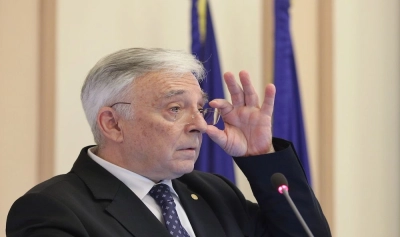
Sursă foto: Inquam Photos / Octav Ganea
Distribuie articolul


Distribuie articolul

Explorează subiectul

București 9°C
9°C
9°CArticole Similare

22
ForMin Toiu reiterates Romania's support for Ukraine at informal meeting of Foreign Affairs Council in Kiev
22

16
“Family Footprints”: Students from Four Countries Explore Family Values through an eTwinning Project
16

15
Gov't approves memorandum for signing of EU-Mercosur Partnership Agreement
15

14
Customs authority, anti-corruption directorate sign collaboration protocol
14

19
EnerMin Ivan:Romania was attacked by Russian Federation 17 times in history, USA has always been an ally
19

12
Government: Capping of markup for basic foods extended until June 30
12

18
Hidroelectrica's Badea: Hydroelectric power plants are not sufficiently backed in Europe
18

16
Andrei (INS): There are controversies over gov't because data are not well understood
16
16
EnergyMin Ivan says decision to cut excise duty on diesel fuel must be made this week
16
22
Ivan, on leaving government: Decision belongs to the 5,000 colleagues in PSD
22

13
Energy crisis puts major pressure on ANRE; over 20 billion RON settled for compensation(secretary general)
13

16
Nicusor Dan: Romania still needs to develop transport infrastructure
16

15
Almost two-thirds of Romanian retail investors do not trust the prospects of the local economy (report)
15















Comentează