



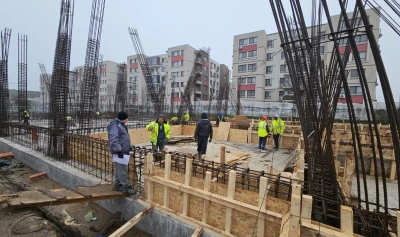


Romania's construction market entered 2026 with strong momentum, operating close to all-time highs and driven mainly by public investments, but also by steady interest from private developers, according to a Colliers analysis.
Construction works rose by almost 8% between January and November 2025 compared to the previous year, nearing the record level of 2023, the report shows. The sector continues to run at high capacity despite mounting pressures and uncertainty.
Construction accounted for almost 9% of GDP in 2025, the highest share in the EU and well above the bloc's 5% average.
Growth is led by engineering works, largely publicly funded infrastructure and major hospital projects, which reached record levels in 2025. Non-residential construction increased by over 11% year-on-year, approaching its 2023 peak, while residential construction grew by over 12%, remaining above pre-pandemic levels despite staying below recent highs.
Overall, construction activity in 2025 was nearly double the pre-pandemic level.
"The data clearly shows that the Romanian construction market is operating at very high speed, close to historical highs, mainly supported by large public projects. We are talking about work volumes - that is the intensity of activity - not the financial value of investments, which makes the results even more impressive. If we maintain this pace, the country will look very different in 10 years," said Alexandru Atanasiu, Partner | Head of Construction Services.
Still, short- and medium-term prospects are clouded by new pressures. A carbon tax on construction materials imported from outside the EU came into force in 2026. Initial estimates point to a 10 - 15% cost impact. Given Romania's heavy reliance on imported steel, aluminium and other metals, companies are unlikely to absorb the full increase, meaning higher project costs and potentially weaker private-sector appetite for new investments.
Global geopolitical tensions have also pushed up material prices. In 2025, indices for several construction materials hit record levels in Europe and the US. Copper prices rose by more than 40%, reaching historic highs, while other base metals also saw significant increases.


On the labor market, construction employment reached a record 462,000 workers in July 2025, up 1% year-on-year. A slight decline in the following months is attributed to seasonality, not a change in trend. Despite wage pressures, Romanian construction salaries remain below those in other Central and Eastern European countries, giving companies some flexibility. Operating margins in the sector remain above the EU average, offering a buffer against rising costs.
"In the first three quarters of 2025, construction represented 8.7% of GDP, the highest share in the EU. This shows how much the economy relies on construction, but also highlights a vulnerability, as more than half of activity depends on EU-funded engineering works. Any delays in accessing European funds could have a visible impact on the sector and the wider economy," Atanasiu added.
For 2026, Colliers expects a more balanced market, with activity still supported by public investments, assuming political stability. Private investors are already adjusting plans and timelines in anticipation of a potential medium-term market rebound.
Colliers is a global leader in real estate consulting and investment management, with annual revenues of nearly $5.5 billion, a team of 24,000 professionals and $108 billion in assets under management.

























Comentează