



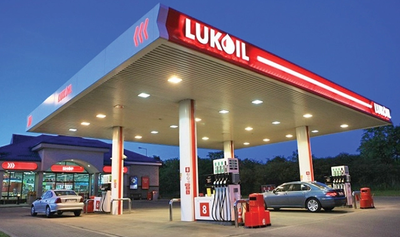


Lukoil Overseas Atash BV, a subsidiary of the Russian company Lukoil, has sued the Romanian state, citing a case of force majeure, after the company withdrew from the "Trident" offshore natural gas project in the Black Sea.
The action was filed at the Bucharest Court and has as its object "action to establish the existence of a case of force majeure", and the defendants are Romgaz and the National Agency for Mineral Resources - General Directorate of Oil and Gas Concessions.
On February 11, the Ministry of Energy recommended the establishment of extended surveillance measures on entities owned in Romania by the Lukoil group.
Also, Lukoil announced that it is withdrawing from the "Trident" offshore natural gas project in the Black Sea.
Lukoil Overseas Atash B.V. Amsterdam Netherlands and Societatea Nationala de Gaze Naturale Romgaz SA have joined forces within the Trident offshore natural gas perimeter in the Black Sea, where Lukoil Overseas Atash BV Branch holds the status of operator and majority shareholder, and the Romanian state participates through Societatea Nationala de Gaze Naturale Romgaz SA.
"Lukoil's withdrawal from the Trident project is not just a corporate move in an offshore perimeter. It is an X-ray of our energy vulnerabilities and strategic delays accumulated over the last decade. When an investor invokes force majeure in a strategic project in the Black Sea, the problem is no longer just contractual. It becomes geopolitical, economic and, above all, European. Trident was, on paper, one of the potential pieces of the energy security puzzle of Romania and Europe. Not nearly as advanced as Neptun Deep, but promising enough to matter in a region that is trying to replace gas dependence with regional production. The irony? A project meant to reduce Europe's gas dependence on Russia ended up being blocked precisely because of the sanctions imposed on Russia," said Dumitru Chisalita, president of the Smart Energy Association (AEI), on Tuesday.
It shows that Lukoil's invocation of force majeure essentially represents the recognition that Western sanctions make it impossible to continue operations normally.
The AEI president states that Lukoil's withdrawal is not just about sanctions, but about the fact that the energy strategy cannot be built on improvisation and reaction.
"The Romanian statute must decide quickly: whether force majeure is accepted or contested; whether the perimeter is put out to retender and whether it actively supports a solution to replace the operator. More importantly, it must send a clear signal: strategic projects cannot remain in ambiguity for years," he added.
According to the specialist, Lukoil's withdrawal may also represent an opportunity.
"A repositioning of the project under an operator without the risk of sanctions could make Trident more bankable than before. In the current European context, Black Sea gas is no longer just a commodity, but a strategic opportunity for Romania to consolidate its position as a regional energy security pole. The real question is not whether Lukoil is leaving, but whether Romania knows how to transform this withdrawal into a new beginning," Dumitru Chisalita also said.








Comentează