



President Klaus Iohannis maintains that the Black Sea region must remain a stable and predictable space, pointing out that it needs a better collaboration in the region.
"We all want the Black Sea area to remain a stable and predictable space, however reaching this goal needs overcoming a great obstacle: all participants in this great strategy game at the Black Sea should rather regard the region as a convergence area of objectives and less a border dividing diverging interests. The key is overcoming the historical animosities and identifying the complementarity of interests for each of the countries in the region, in other words, a better collaboration," the head of state says in a message sent on the occasion of opening the works of the programme "Security in the Black Sea Region. Common Challenges, Sustainable Future," which was presented by Presidential Adviser Ion Oprisor, according Agerpres.
He points out that Romania has constantly stressed the need of a sturdy regional cooperation and voiced the availability of working with all partners interested in developing the Black Sea area.
"Romania represents, at this moment, a pole of stability, in the context of some concerning regional and international developments. Our country has proved it is a trustworthy partner and can contribute to ensuring the regional security on multiple levels - political, diplomatic, military - and it is prepared to deal with the security challenges. The progress on the path of stabilizing the region for sustainable development absolutely needs a much more active and more pragmatic approach of the states in this area, as well as a more consistent involvement of the West. It is the main reason for which we'll further make efforts aimed at increasing the visibility of the Black Sea region on the Euro-Atlantic agenda," Klaus Iohannis' message reads.
He says that the current international context reveals the worsening of some complex and dynamic threats against the stability of the extended Black Sea region.
"Under the influence of the political and military events over the recent years, this area has become a meeting place of various influence spheres, being placed at the crossroads of some sensitive geopolitical and geo-economic borders. The are represents a sea border of the North Atlantic Organization and the European Union, but, at the same time, a corridor of strategic access to Central Asia and the Middle East, a picture additionally complicated by the Russia-Turkey-Iran axis," Iohannis says.
The head of state points out that a debate is needed the results of which should contribute to diminishing the conflict nature of the region and a better capitalisation on the outstanding potential of the Black Sea. He says that an assessment of the security context must take into account a diversified agenda, in which the economic, cultural, social or identity aspects come to supplement the military and political dimension.
"I believe that a special attention must be granted to the nature of the region as a space at the confluence of some varied identities - a mosaic of states, nationalities and ethnicities, with own historic traditions, cultural and religious values," Iohannis shows.
The head of state points out that instability in the area is perpetuated by the state entities belonging to different security or economic spaces.
"It is a complicated picture, and the various stages of development of the countries in the area might negatively reflect on their capacity to cooperate," he maintains.
According to President Iohannis, the frozen conflicts in Abkhazia, South Ossetia, Transnistria and Nagorno-Karabakh, the situation in Ukraine, alongside the "eruptive potential of some identity cleavages," such as those in Trans-Carpathia or the Northern Caucasus continue to threat the stability and security of the region.
He shows that the economic dimension mustn't be underestimated.
"The Black Sea region represents the entry gate for the oil and gas sent from Central Asia and the Caucasus to Europe. Thus, the security of the energy infrastructure in this sector becomes critical to the energy security of Europe. The Black Sea area is important to the Russian Federation. Within the strategy to consolidate the status of political-military power on a regional and international level, Moscow relied on maintaining its political, economic-energy and military overbearing in this area," the head of state says.
Klaus Iohannis: We want the Black Sea area to remain a stable and predictable space
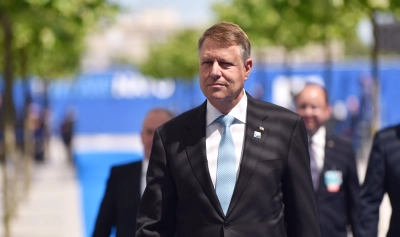
Sursă foto: www.presidency.ro
Distribuie articolul


Distribuie articolul

Explorează subiectul

București 9°C
9°C
9°CArticole Similare
10
ForMin Toiu reiterates Romania's support for Ukraine at informal meeting of Foreign Affairs Council in Kiev
10

10
“Family Footprints”: Students from Four Countries Explore Family Values through an eTwinning Project
10

10
Gov't approves memorandum for signing of EU-Mercosur Partnership Agreement
10

12
Customs authority, anti-corruption directorate sign collaboration protocol
12
16
EnerMin Ivan:Romania was attacked by Russian Federation 17 times in history, USA has always been an ally
16

10
Government: Capping of markup for basic foods extended until June 30
10

17
Hidroelectrica's Badea: Hydroelectric power plants are not sufficiently backed in Europe
17

10
Andrei (INS): There are controversies over gov't because data are not well understood
10
15
EnergyMin Ivan says decision to cut excise duty on diesel fuel must be made this week
15
19
Ivan, on leaving government: Decision belongs to the 5,000 colleagues in PSD
19
11
Energy crisis puts major pressure on ANRE; over 20 billion RON settled for compensation(secretary general)
11
14
Nicusor Dan: Romania still needs to develop transport infrastructure
14

13
Almost two-thirds of Romanian retail investors do not trust the prospects of the local economy (report)
13













Comentează