



President Klaus Iohannis says the challenges in the health, energy or security area will not cease to exists, for which reason proper mobilisation is needed, in relation with the national and regional stratefic interests, to ensure resilience and security, agerpres reports.
"The health crisis is not only a tough lesson, but also the occasion to generate a change in the development models of states and to create a new paradigm in economy with a focus on sanitary, energy or food security. (...) The health crisis has shown us that security and resilience remain the core of power of each state. The instruments needed to protect against the malicious use of the new technologies nonetheless exceed the capabilities of one single country, therefore only together can we reduce the risks induced by these dangers. Romania endorsed the need for extended international dialogue for shaping up the rules on emerging technologies. in line with the democratic principles and values, which we identify with: protecting human rights, fundamental freedoms and rule of law observance. From this perspective it is of outmost importance to ensure the coordination and complementarity of the initiatives carried out by NATO and the EU. In line with this common effort is Romania's initiative of setting up in Bucharest the Euro-Atlantic Centre for Resilience, which will build a pole of excellency and an expertise supplier for NATO and the European community. (...) The challenges in the health, energy or security area will not cease to exist, that is why we must get properly mobilised, in relation with the national and regional strategic interests, to ensure our resilience and security," Iohannis says in the message addressed to Bucharest Forum 2021, delivered by Presidential Adviser Cosmin Marinescu.
Iohannis shows that in the area of energy security, this year, there is a crisis generated by the strong increase in energy prices.
"I believe a convergent approach on medium and long-term is needed all over the European Union, aimed at the structural problems of the energy sector, as well as those of the common market in the energy area. Reducing dependence on third suppliers outside the EU, increasing energy independence and diversifying the energy supply sources are but some of the sustainable solutions we must bet on," Iohannis also says.
He brings to mind that last month he requested the European Commission to include the nuclear energy and natural gas in the EU Taxonomy Climate Delegated Act legislative package, to be presented as soon as possible.
"Romania benefits from a balanced energy mix, but we need new sustainable energy capacities, to confirm the potential of becoming an important regional player in this area. The exploitation projects for offshore natural gas in the Black Sea are an opportunity we must responsibly capitalise on. I am positive that the Neptun Deep project, to be managed by OMV Petrom and Romgaz, will start as soon as possible and will represent a model for future initiatives," Iohannis says.
Iohannis also shows that, in the nuclear energy area, Romania has a very good collaboration with the strategic partner - U.S., bringing to mind the recent conclusion of the agreement on the integration of small modular reactors in Romania's energy system.
"Romania is aiming at reaching an efficient balance on long term between the CANDU reactors and new technologies, counting, in this regard, on a close cooperation with France, based on the Strategic Partnership," Iohannis also mentions.
He underscored the importance of digitisation, pointing out that Romania, which is ranked fourth in the EU in regards to IT graduates, must capitalise on in this respect.
"An economy's capacity of adaptation is closely linked with the digitisation level, The pandemic has sped up the automation trends, the use of artificial intelligence and blockchain technologies and proportionally the need for proper cyber security. (...) Romania has planned for the period ahead more than a mere recouping of gaps on the digital society area. Thus, the measures for supporting the digital transition represent a fifth of the total of 29 billion euros from the National Recovery and Resilience Plan (PNRR). These measures can sustain a wide technological leap through consistent investments in the IT&C infrastructure, as well as through supporting innovation, integration of new technologies and adapted digital skill development," Iohannis highlights, mentioning that Romania has become the host of the European Cybersecurity Industrial, Technology and Research Competence Centre.
Iohannis: Challenges in health, energy or security area won't cease to exist; we must get mobilised
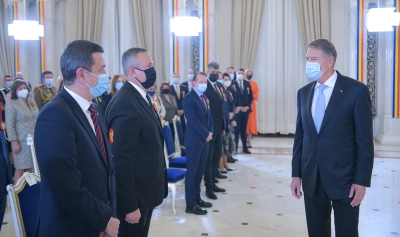
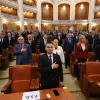
Sursă foto: presidency.ro
Distribuie articolul


Distribuie articolul


București 9°C
9°C
9°CArticole Similare
17
ForMin Toiu reiterates Romania's support for Ukraine at informal meeting of Foreign Affairs Council in Kiev
17

10
“Family Footprints”: Students from Four Countries Explore Family Values through an eTwinning Project
10

11
Gov't approves memorandum for signing of EU-Mercosur Partnership Agreement
11

13
Customs authority, anti-corruption directorate sign collaboration protocol
13
17
EnerMin Ivan:Romania was attacked by Russian Federation 17 times in history, USA has always been an ally
17
10
Government: Capping of markup for basic foods extended until June 30
10
17
Hidroelectrica's Badea: Hydroelectric power plants are not sufficiently backed in Europe
17

11
Andrei (INS): There are controversies over gov't because data are not well understood
11
15
EnergyMin Ivan says decision to cut excise duty on diesel fuel must be made this week
15
19
Ivan, on leaving government: Decision belongs to the 5,000 colleagues in PSD
19
11
Energy crisis puts major pressure on ANRE; over 20 billion RON settled for compensation(secretary general)
11
14
Nicusor Dan: Romania still needs to develop transport infrastructure
14

13
Almost two-thirds of Romanian retail investors do not trust the prospects of the local economy (report)
13










Comentează