



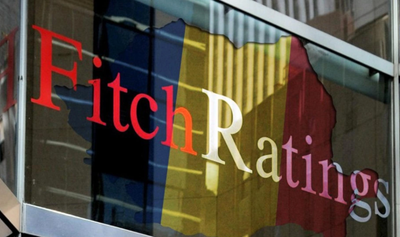


Fitch Ratings has affirmed Romania's Long-Term Foreign-Currency (LTFC) Issuer Default Rating (IDR) at 'BBB-' with a Negative Outlook, according to a press release the credit rating agency issued on Friday.
"Romania's 'BBB-' rating is supported by EU membership and related capital inflows that have supported income convergence and access to external financing. GDP per capita and governance are above 'BBB' category peers. These strengths are balanced against the large and persistent twin budget and current account deficits, increasing public debt, political polarisation and fairly high net external debt," the aforementioned press release reads.
According to the source, the Negative Outlook reflects the continued deterioration of public finances due to large, albeit declining, fiscal deficits and rapidly rising government debt/GDP. The government formed in summer 2025 has started to implement significant fiscal consolidation measures that will lead to significant fiscal consolidation in 2026, although the 2026 budget is not yet adopted. Significant risks to medium-term fiscal consolidation persist, in our view, due to weak growth, implementation challenges, fiscal fatigue and tensions within the four-party government coalition.
"The swift implementation of consolidation measures by the new Bolojan government, including the August 2025 VAT increase, put the budget deficit on a declining trend from record high levels. Based on the preliminary cash data (7.7% of GDP deficit), we estimate that the ESA budget deficit was close to 8% of GDP last year. The full-year implementation of the 2025 measures and the expenditure freeze for 2026 could narrow the ESA deficit by almost 2pp of GDP in 2026," the agency's release points out.
However, there is uncertainty about the magnitude of additional fiscal consolidation in 2027 and beyond, including due to the planned change in premiership in April 2027 and the 2028 electoral cycle. Romania's general government deficits will remain among the highest in the 'BBB' category over the forecast horizon, Fitch warns.
Gross general government debt increased rapidly in the past two years, therefore Fitch estimates it was almost 59% of GDP at end-2025, above the 'BBB' current median of 56%. The agency projects that the debt/GDP ratio will rise to 63% in 2027 and, without further measures, will continue to climb.


GDP growth remained below 1% in 2025, as the substantial fiscal consolidation and weak external demand constrain Romania's economic performance. Fitch forecasts GDP growth to remain below its 2% potential until 2027, given expectation of additional fiscal tightening, which highlights the difficult policy trade-offs. Household consumption will fall this year due to the prolonged fall in real disposable incomes. Nevertheless, investments will grow strongly, due to the counter-cyclical stimulus of EU funds, reinforced by the increased grant component of the Recovery and Resilience Plan.
High inflation is a rating weakness for Romania, exacerbated by the temporary inflationary impact of VAT rate hike and the expiry of the electricity price cap. Inflation has been above the National Bank of Romania's 2.5% +/-1pp target for five years and three-year average inflation for 2024-2026 is double the current 'BBB' median.
The current account deficit (CAD) was close to 8% of GDP in 2025, compared with 6.7% in 2023 and significantly above the 'BBB' current median of 1%. We forecast the CAD will shrink to less than 7% of GDP in 2026, primarily due to the fall in import demand from public and private consumption. We forecast net external debt will gradually increase from 21% of GDP in 2024, significantly above the projected 3% for the 'BBB' median.
Substantial EU funds support Romania's access to external financing to cover its large twin deficits, which highlights the benefits EU membership. Beyond the cohesion funds, the increased RRP grants in the last year of the programme and, most recently, the access to Security Action for Europe loans (EUR16.7 billion), including EUR 2.5 billion pre-financing, at favourable terms, will help somewhat ease cost of financing pressures and mitigate near-term external financing risks, says Fitch.
Fitch finds the factors that could, individually or collectively, lead to negative rating action/downgrade would be the failure to implement additional fiscal consolidation measures that would result in public debt stabilisation over the medium term, as well as evidence of adverse spillovers to external financing and liquidity, or macroeconomic stability, stemming from heightened political tensions or persistently high twin fiscal and CADs.
Fitch identifies as factors that could, individually or collectively, lead to positive rating action/upgrade the confidence that steady progress with the fiscal consolidation will support stabilisation of public debt/GDP over the medium term could lead to a revision of the Outlook to Stable, as well as the reduction in external indebtedness and external financing risks, stemming from a structural improvement of the CAD, the report also shows.

























Comentează