



Governor of the National Bank of Romania (BNR) on Friday commended the government's maintaining the budget deficit below the 3 pct reference level, which kept the GDP share of the public debt below 40 percent, but cautioned that with economic growth as high as Romania's in 2017 "one should seek to stay below this limit."
"I welcomed the fact that the government has kept the deficit below the 3 percent benchmark, which has maintained the government debt's GDP share below 40 pct. As you know, the critical level in the EU is 60 pct, but for emerging countries like Romania 40 - 45 percent is considered to be critical. The fact that we keep the public debt below 40 pct is positive, but a less positive aspect is that this 3 percent occurs against an extremely high economic growth - both in relative and historical terms - therefore the structural deficit, as calculated, is a less visible parameter, so to speak, but economists calculate it though, and it has shot up from 2.2 pct to over 3 pct, and it is sensibly superior to the medium term target of 1 percent. We, the National Bank, hope we don't preach in vain when we insist that fiscal policy should not be pro-cyclical. It has to when you have such economic growth, you should not stay at the 3 percent deficit limit, but try to position yourself below," Mugur Isarescu told the conference for the presentation of the Report on inflation.
According to him, the rise in the 2017 structural deficit was also accompanied by an unfavorable structure of public investment. Consequently, short-term and strategic long-term interests are in an unfavorable relation.
There is need for more substantial growth in public investment because it is an essential factor for long-term economic development, Isarescu said.
The BNR governor also cautioned against the widening of the unfavorable gap between the imports and exports' growth rate (12 pct vs. 9 pct, respectively), as the monthly trade deficit has frequently exceeded 1 billion euro in H2, as well as against the delayed resumption of funding from structural and investment European funds, with an absorption rate of just 10 percent under the current financial programming period (2014 - 2020).
On top of that, the number of employees in the labor market hit an all-time high of 4.8 million, but despite that there are persistent structural deficiencies and a 33 percent inactivity rate (placing Romania 3rd in the EU), a high share of young people who are not participating in any activity (20 pct), limited internal mobility and a serious inconsistency of training with market requirements.
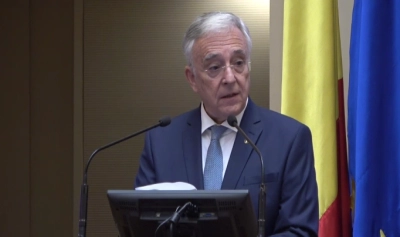
BNR governor: With so high economic growth, budget deficit should be kept below 3 pct limit
Sursă foto: captura TV
Distribuie articolul


Distribuie articolul

Explorează subiectul

București 12°C
12°C
12°CArticole Similare

2
Energy crisis puts major pressure on ANRE; over 20 billion RON settled for compensation(secretary general)
2

8
Nicusor Dan: Romania still needs to develop transport infrastructure
8

10
Almost two-thirds of Romanian retail investors do not trust the prospects of the local economy (report)
10

10
HealthMin Rogobete: At the moment, we are not in a medicine crisis
10

15
INS: Romania counts 113,303 enterprise groups in 2024, 108,401 of them multinationals
15

18
Survey: 75% of Romanian employees feel financial pressure, over a third seek extra income
18

19
PM Bolojan: Romania does not need a political crisis at the moment, it needs stability
19

29
Hanwha Aerospace allocates 1.3 billion euro to strengthen Romania's sovereign defence capabilities
29

19
ForMin Toiu attends informal meeting of the Foreign Affairs Council in Kyiv
19

14
Project on effective use of EU funds, sustainable development to be launched in Bucharest
14

18
Albanian PM: Aims to conclude EU accession talks by 2027, join by decade's end
18

13
PM Bolojan: EU's eastern border must be stronger; we need to strengthen both military and economic security
13

20
INTERVIEW/U.S. ambassador to Bucharest: Our partnership has never been stronger, we aim to advance economic opportunities
20















Comentează