



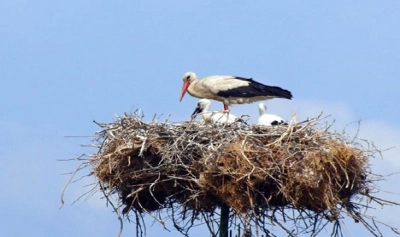


The bird and nature protection organisation Milvus Group from Targu Mures announced on Wednesday that the two webcams streaming from the stork nests in Dumbravioara have been activated for the 20th consecutive year. First launched in 2006, these broadcasts marked the first initiative of this kind in Romania.
"The two webcams in the stork nests have been turned on. Starting today, we can once again follow together the live stream from the two monitored nests in Dumbravioara (Mures County), and we eagerly await the arrival of their new residents. It is a special moment, as 20 years have passed since we installed the first camera in 2006," the organization noted. Milvus also explained that the stork feeds on wet meadows and agricultural land, with its diet shifting by season - rodents and insects during drought, aquatic animals such as frogs and grass snakes during rainy periods. A pair typically raises 3 - 5 chicks annually, depending on weather and food availability.
In the early years (2006 - 2009), the images could be viewed only at the local stork museum, but since 2010 the life of a stork family has been streamed online - the first such broadcast in Romania. In 2012, the old camera was replaced with one equipped with night vision, and since 2019 Milvus has been streaming from two nests, Milvus Group said on its website.
Milvus ornithologists emphasize that the white stork is one of Europe's most beloved birds, with both male and female renewing their imposing nests year after year.
The organization also recalls that last year, chicks in one of the monitored nests in Dumbravioara perished, with similar cases reported elsewhere. "Extreme weather conditions are beyond our control. Cold and rainy springs are among the most lethal factors for stork chicks, especially in the first 10 - 20 days of life. Hypothermia and low immunity make survival difficult, even with attentive parents. In the wild, storks often lay more eggs than they can raise, and some chicks die naturally when food is scarce. What may seem cruel - such as pushing away or abandoning a chick - is sometimes the instinctive response of parents to conserve resources for the strongest offspring," Milvus explained.
The organization cites two studies on chick mortality in Germany and Poland. The German study found that 44.6% of dead chicks under 23 days old had fungal pneumonia caused mainly by Aspergillus fumigatus, favored by humidity in the nests. The Polish study concluded that temperature and precipitation indirectly affect food availability - such as insects, amphibians, and small mammals - leading to starvation or slowed growth, while cold exposure increases the chicks' vulnerability.


Ornithologists stress that intervention is not advisable, as mortality caused by severe weather - rain, cold, strong wind, drought - is part of natural selection. "Severe weather disproportionately affects weaker or less adapted chicks, ensuring the survival of the strongest individuals. Our principle in nature conservation is not to intervene in natural processes, however painful they may be. The white stork is not an endangered species, and the loss of some chicks, though sad, does not threaten its survival," Milvus emphasized.




























Comentează